Sunscreen
What does SPF actually mean?
SPF, or Sun Protection Factor, is a lab measurement of how much longer protected skin takes to redden under UVB compared with bare skin. SPF 30 means 30× longer under test conditions: a thick, even 2 mg/cm² layer that almost nobody applies in real life. It measures UVB (burning) protection only; UVA (ageing) protection is labelled separately.
What the numbers filter
| SPF | UVB filtered | UVB reaching skin |
|---|---|---|
| SPF 15 | ≈ 93.3% | 1/15th |
| SPF 30 | ≈ 96.7% | 1/30th |
| SPF 50 | ≈ 98.0% | 1/50th |
| SPF 100 | ≈ 99.0% | 1/100th |
Notice the shape: the step from 15 to 30 halves the UV getting through, but 50 to 100 halves an already-tiny remainder. That’s why dermatologists call SPF 30–50 the sweet spot; beyond it, marketing outruns physics.
Why real-world SPF is lower
- Quantity: at the typical quarter-to-half dose people actually apply, SPF falls roughly exponentially: an SPF 30 performs more like 5–10.
- Coverage: missed patches (ears, hairline, tops of feet, back of neck) get SPF 0.
- Time: filters degrade and the layer wears off, hence the two-hour reapply rule.
Don’t forget UVA
UVA penetrates deeper, drives photo-ageing and contributes to skin cancer, and passes through glass. In the UK/EU, look for the UVA circle logo (UVA protection at least a third of the SPF) or a star rating; “broad spectrum” is the US equivalent. A high SPF with poor UVA coverage protects you from the burn while letting the ageing wavelengths through.
How Soleil helps
SPF as an input, not a promise
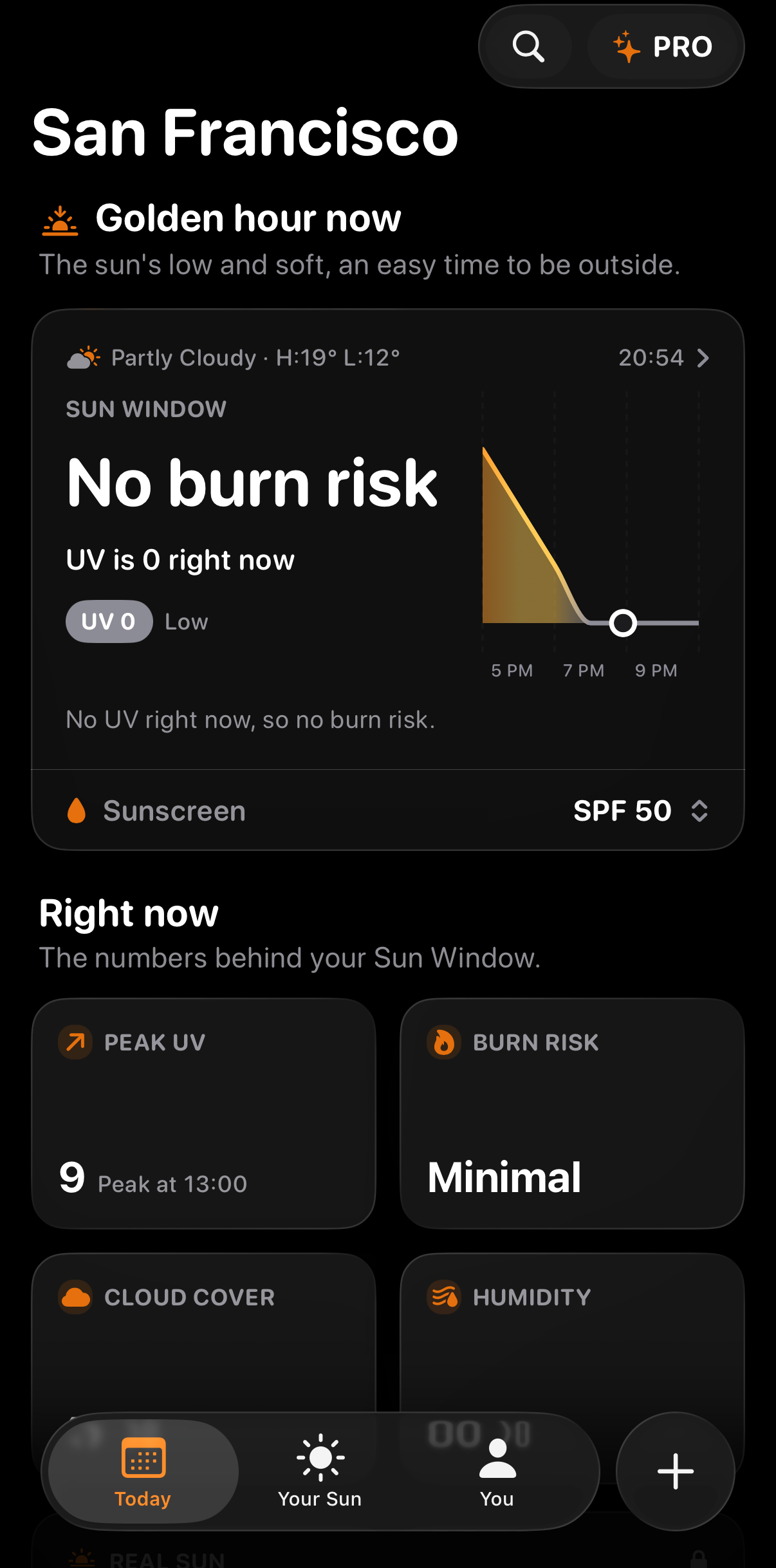
Soleil records which SPF you’re wearing and factors it into your protection-check estimates alongside live UV, your skin type and clothing, using conservative real-world assumptions, not the lab multiplier.
It’s honest by design: logging SPF 50 doesn’t make the timer promise you the whole afternoon, and reapplying never extends a session. The estimate is a prompt to reassess, not permission.
Related questions
-
Is SPF 100 twice as good as SPF 50?
No. SPF 50 already filters about 98% of UVB; SPF 100 filters about 99%. The marginal gain is small, and very high SPFs can encourage longer exposure and less reapplication.
-
Does the SPF in makeup or moisturiser count?
Only partially. Studies show people apply cosmetics far too thinly to reach the labelled SPF, and coverage misses zones like ears and jawline. Treat cosmetic SPF as a bonus layer, not your protection plan.
-
Mineral or chemical sunscreen: does it change the SPF rules?
No. Zinc/titanium (mineral) filters reflect and absorb UV; organic (“chemical”) filters absorb it. Application quantity, coverage and reapplication rules are identical for both.
Soleil is wellness guidance, not medical advice. For sensitive skin or diagnosed conditions, please follow a dermatologist’s plan.