Skin
What’s your Fitzpatrick skin type? The 6 types, explained
The Fitzpatrick scale, developed by dermatologist Thomas Fitzpatrick in 1975, classifies skin into six types based on how it responds to UV: how easily it burns and how readily it tans. It remains the standard shorthand dermatologists use to talk about sun sensitivity, and it’s the single biggest personal factor in how quickly you burn.
The six types
| Type | Typical features | Burns? | Tans? |
|---|---|---|---|
| I | Very fair skin, often freckles; red or blond hair; light eyes | Always, quickly | Never; peels |
| II | Fair skin; light hair and eyes common | Easily | Minimally, with difficulty |
| III | Medium / cream skin; any hair colour | Sometimes, mildly | Gradually and uniformly |
| IV | Olive or light brown skin | Rarely | Easily, to medium brown |
| V | Brown skin | Very rarely | Deeply and easily |
| VI | Deeply pigmented brown to black skin | Almost never | Deeply |
Why it matters
At the same UV index, a Type I and a Type IV person have completely different burn timelines: roughly 15 minutes versus an hour at UV 6. Generic advice (“limit midday sun”) is written for everyone at once; knowing your type is what turns the UV index into a number that means something for your skin.
The scale’s honest limitations
- It was designed around sun response, and self-assessment is subjective; people routinely overestimate how well they tan.
- It doesn’t capture photosensitivity from medication, conditions or recent exfoliation.
- Types V–VI still need sun protection. Melanin is good natural SPF, but skin cancer occurs in all skin tones, and is often caught later in deeper tones.
How Soleil helps
Set it once, and every number becomes yours
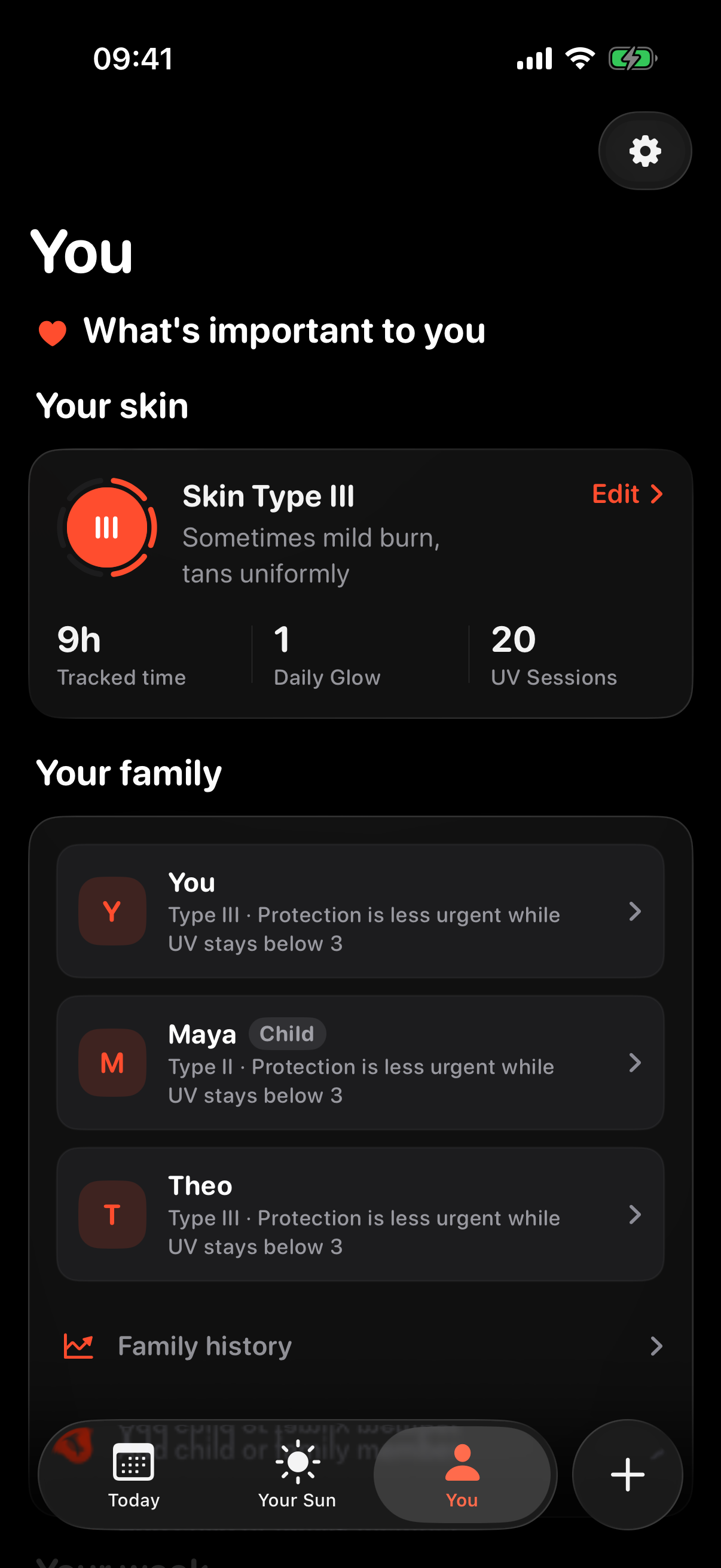
Soleil establishes your Fitzpatrick type during onboarding: answer a short survey, pick it directly, or use the optional AI skin scan (one photo through a secure proxy, never stored, with a fully on-device fallback).
From then on, every protection-check estimate, family profile and session record is calibrated to the skin you actually have, not a population average. You can change it any time in the You tab.
Related questions
-
Can your Fitzpatrick type change?
Your underlying type is genetic and stable. What changes is state: a tan temporarily raises your tolerance slightly, and medication or exfoliation can lower it. Assess yourself against untanned skin.
-
Which skin type is most common?
Globally, Types III–IV are most common. In the UK and Ireland, Types I–II make up an unusually large share, which is why British skin burns so readily on holiday.
-
Do Types V and VI need sunscreen?
Yes, though burn urgency is lower. UV still drives DNA damage, hyperpigmentation and skin cancer in deeper skin tones, and outcomes are often worse because detection is later. Protection advice applies to everyone at high UV.
Soleil is wellness guidance, not medical advice. For sensitive skin or diagnosed conditions, please follow a dermatologist’s plan.