Sun safety
How long can you stay in the sun without burning?
There is no single answer: the time it takes skin to start burning depends on the current UV index and your Fitzpatrick skin type. At UV 6, very fair skin (Type I) can start to redden in roughly 15–20 minutes unprotected, while deeply pigmented skin (Type VI) may tolerate two hours or more. Double the UV index and the time roughly halves.
Every figure below is an estimate for intact, unprotected adult skin, not a personal safety promise. Altitude, water and sand reflection, medications and patchy sunscreen all shorten it.
Approximate time to first redness, by skin type
Dermatology references express burn time as a “minimal erythemal dose”: the UV energy at which skin visibly reddens. Converted to minutes at a UV index of 6 (a typical high-summer afternoon in the UK), unprotected estimates look like this:
| Fitzpatrick type | Typical features | Approx. time at UV 6 |
|---|---|---|
| Type I | Very fair, always burns, never tans | ≈ 15–20 min |
| Type II | Fair, burns easily, tans minimally | ≈ 20–30 min |
| Type III | Medium, sometimes mild burn, tans uniformly | ≈ 30–40 min |
| Type IV | Olive, rarely burns, tans well | ≈ 40–60 min |
| Type V | Brown, very rarely burns | ≈ 60–90 min |
| Type VI | Deeply pigmented, almost never burns | ≈ 90 min + |
What shortens the estimate
- Reflection. Water, white sand and snow bounce UV back at you; snow can nearly double your dose.
- Altitude. UV rises roughly 10% per 1,000 m of elevation.
- Patchy sunscreen. Most people apply a quarter to a half of the tested amount, so real-world SPF is far below the number on the bottle.
- Medication and skin conditions. Some antibiotics, retinoids and conditions increase photosensitivity. Follow your clinician’s advice, not a table.
- Wet or exfoliated skin. Freshly scrubbed or wet skin burns faster.
Does sunscreen multiply your time?
In theory, SPF 30 multiplies your unprotected time by 30. In practice it doesn’t, because application is thin, uneven and wears off with water, sweat and towelling. That’s why dermatologists say reapply at least every two hours rather than “SPF 50 lasts all day”. Treat sunscreen as risk reduction, not a licence to stay out indefinitely. See what SPF actually means.
How Soleil helps
Let Soleil do this maths, live
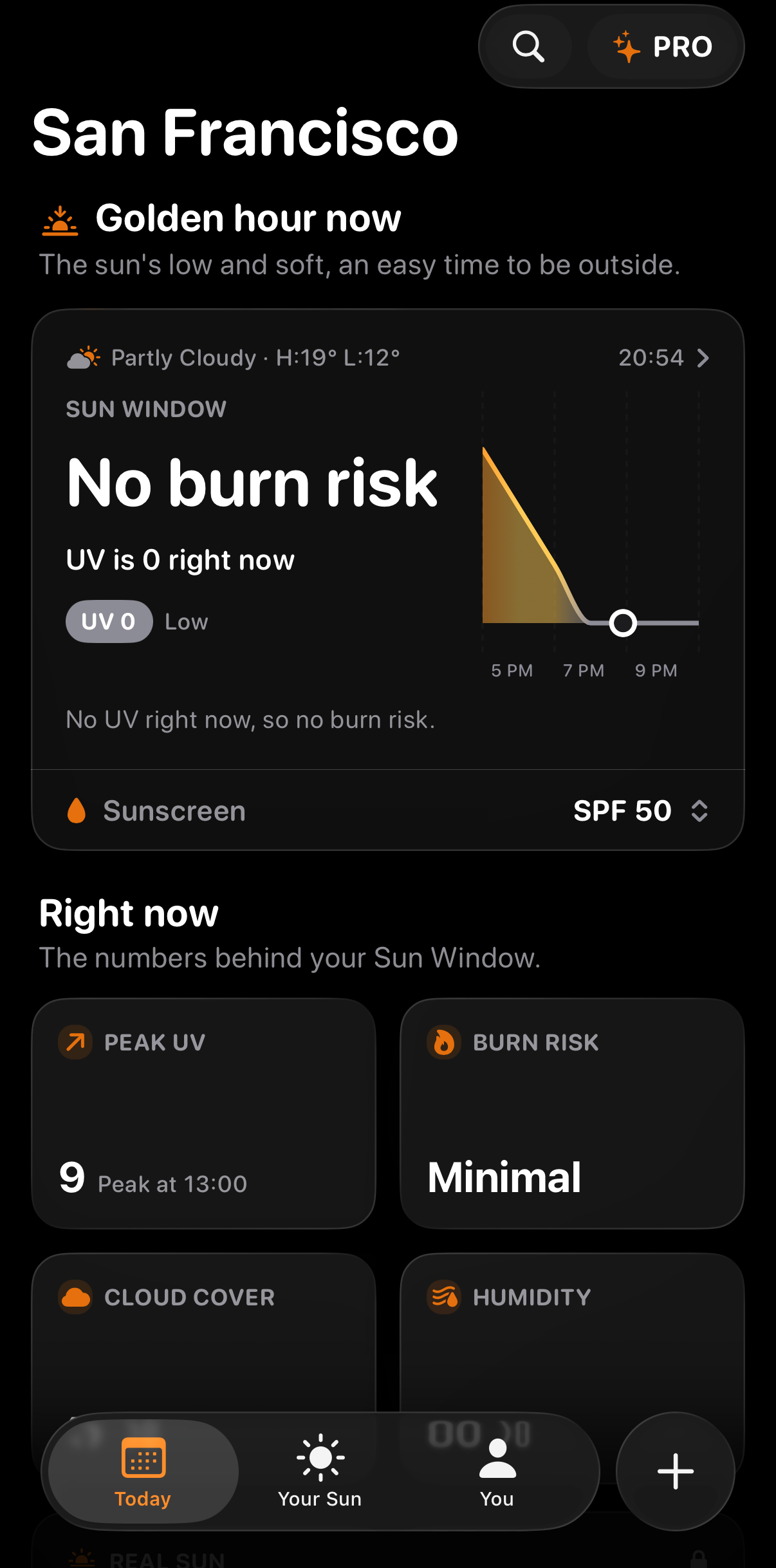
Soleil takes the live UV index for where you are (from Apple WeatherKit), your Fitzpatrick skin type, your SPF and what you’re wearing, and turns them into a personal protection check: a reminder to reassess shade and sunscreen before the estimate runs out, with a live ring on your phone and in the Dynamic Island.
It deliberately frames the number as a check, not permission: reapplying sunscreen never “resets” your time outside. Start a session when you head out and Soleil keeps watch while you enjoy the day.
Related questions
-
Do you burn faster in water or on sand?
Yes. Water and sand reflect UV onto your skin, and being in water offers little protection, because UV penetrates the surface. Swimmers and beachgoers typically receive a higher dose than the UV index alone suggests.
-
Can you burn at high altitude even when it is cold?
Yes. UV increases about 10% per 1,000 m of altitude, and snow reflects up to 80% of UV. Skiers can burn badly on freezing days; temperature has no effect on UV.
-
If I use SPF 50, can I stay out all day?
No. Lab SPF numbers assume a thick, even layer that nobody applies in real life, and protection degrades with water, sweat and towel-drying. Reapply at least every two hours and use shade and clothing during peak UV.
Soleil is wellness guidance, not medical advice. For sensitive skin or diagnosed conditions, please follow a dermatologist’s plan.