Wellbeing
How much sun do you need for vitamin D?
In summer, most lighter-skinned adults make adequate vitamin D from roughly 10–30 minutes of midday sun on forearms and lower legs, two to three times a week, well under typical burn times. Deeper skin tones need meaningfully longer (often 30–60 minutes) because melanin filters UVB. Burning adds nothing: vitamin D synthesis plateaus long before your skin reddens.
The variables that actually matter
| Factor | Effect on vitamin D synthesis |
|---|---|
| Skin tone | Melanin filters UVB, so deeper skin tones need several times longer for the same dose. |
| Latitude & season | Above roughly 35–40° latitude (including all of the UK), winter sun is too weak: from about October to March the UVB needed simply doesn’t reach the ground. |
| Time of day | UVB peaks around solar noon. “Little and often around midday” beats long evening exposure, when UVB is negligible. |
| Skin exposed | Forearms + lower legs beats face + hands alone; more skin, shorter time needed. |
| Age | Skin over ~65 synthesises noticeably less vitamin D from the same exposure. |
| Glass | Window glass blocks UVB, so you make essentially no vitamin D indoors by a sunny window. |
The UK winter problem
The NHS advises that everyone in the UK consider a daily 10 microgram (400 IU) supplement from October to March, because the sun is simply too low for skin synthesis regardless of how long you spend outside. Time outdoors in winter is still excellent for daylight, mood and sleep; it just isn’t a vitamin D source at UK latitudes.
How Soleil helps
See the sun you actually got
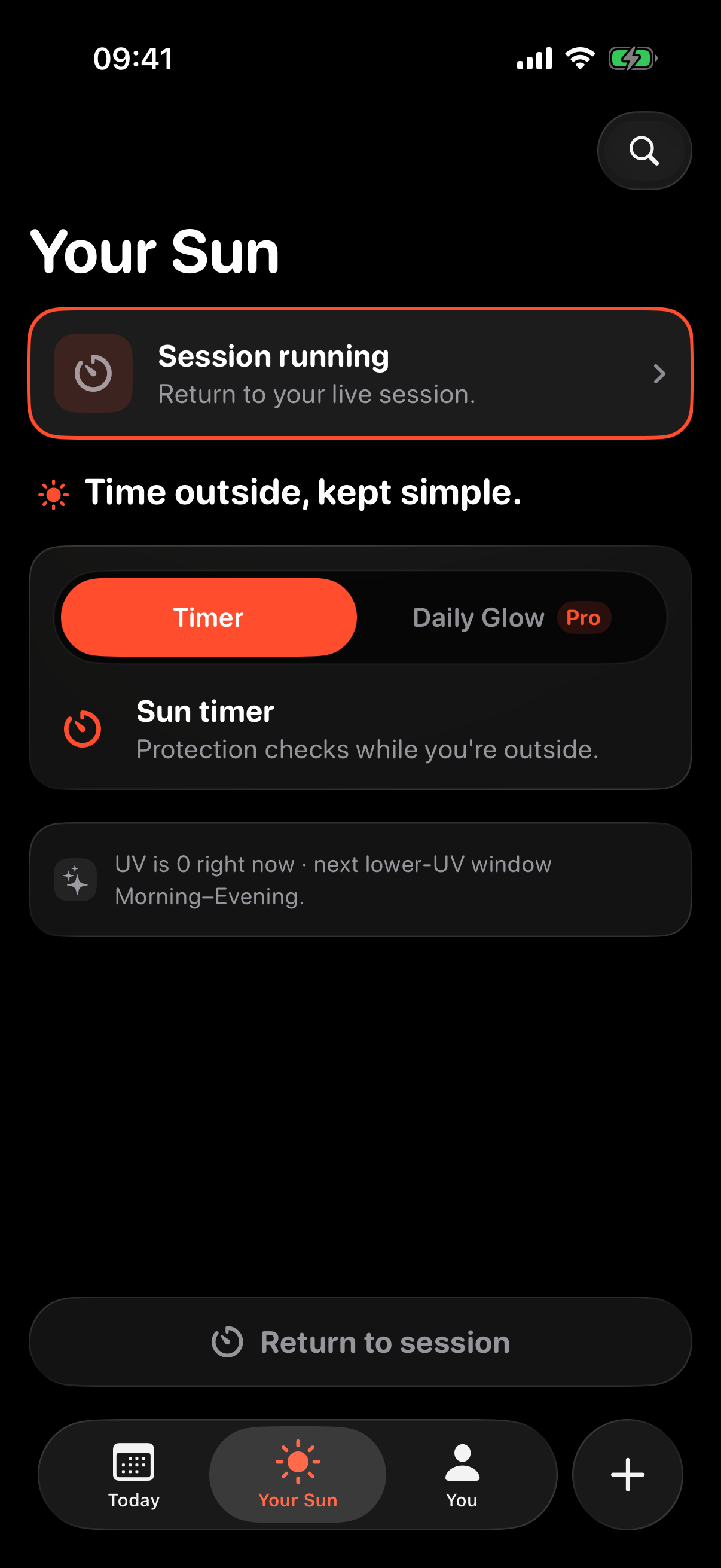
Soleil deliberately does not convert sunlight into vitamin D numbers, because turning UV into IU involves so many personal unknowns that a precise figure would be false confidence. What it gives you instead is the honest raw material: your recorded time outside, and the UV that was around while you were out.
With Pro, Real Sun places your Apple Watch Time in Daylight against the day’s UV curve, so you can see whether your outdoor time landed in gentle morning light or the strong midday window that drives synthesis, and answer “did I actually get outside enough this week?” from real data.
Related questions
-
Can you get vitamin D through a window?
No. Standard glass blocks virtually all UVB, the wavelength skin needs for vitamin D synthesis. A sunny windowsill feels warm because of visible light and infrared, but produces essentially no vitamin D.
-
Do you make vitamin D on a cloudy day?
Some. Thin cloud still passes a substantial fraction of UVB in summer. Heavy grey cloud cuts it dramatically. In winter at UK latitudes, cloud is irrelevant: there is too little UVB either way.
-
Can you overdose on vitamin D from sunshine?
No. Skin regulates itself: prolonged exposure degrades excess previtamin D. Toxicity only occurs from very high supplement doses, never from the sun. The sun’s real limit is skin damage, not vitamin D excess.
Soleil is wellness guidance, not medical advice. For sensitive skin or diagnosed conditions, please follow a dermatologist’s plan.